Kindle eBook
When Science Became Political
The Crisis Inside NIH, CDC, and HHS
About the book →Coleman Publishing · 2026
COVID-19 and the Cost of Certainty
In spring 2025, 77% of American adults said they trusted the CDC's health recommendations. One year later, 50% did.
This book asks what that number was actually measuring — and whether it can be rebuilt before the next pandemic arrives.
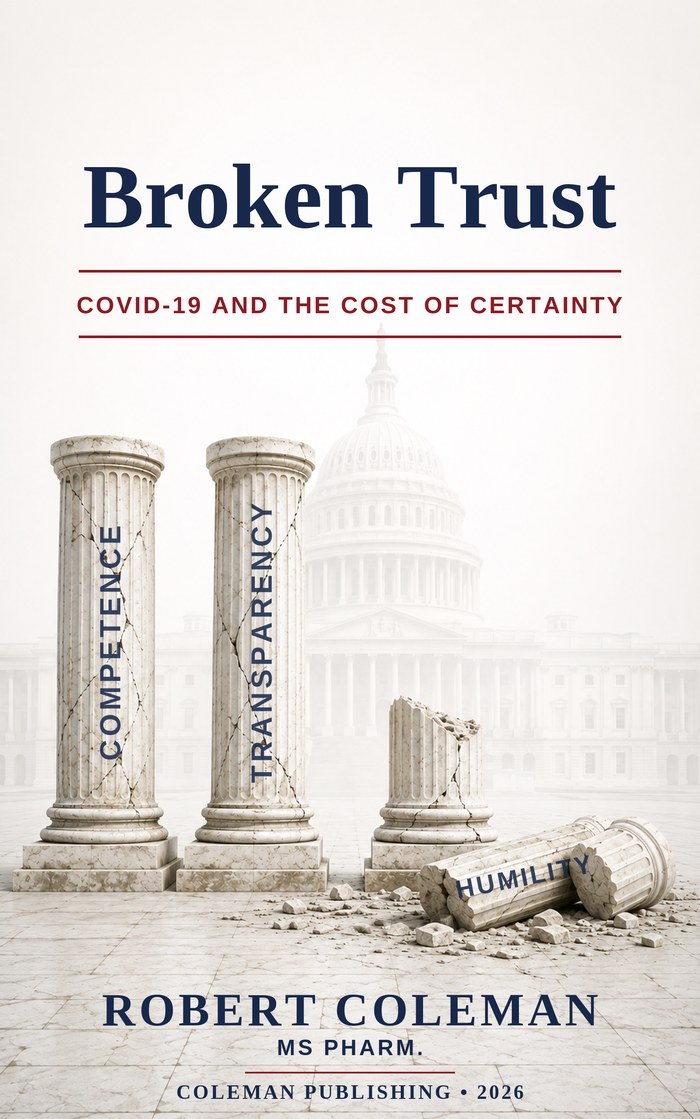
Competence. Does an institution know what it is doing, and succeed at the tasks it claims as its own? Transparency. Does it show its work, including the parts that cut against its conclusions? Humility. Does it acknowledge what it does not know, correct itself openly, and treat challenge as information rather than insubordination?
All three are necessary. Competence without transparency produces suspicion. Transparency without competence produces alarm. Either without humility produces brittleness — an institution that cannot revise without appearing to collapse.
During COVID-19, American public health institutions were placed under pressure on all three at once. Broken Trust documents what happened to each one, in order — and argues that the pandemic's deepest wound was not the virus itself, but what the response to it did to the relationship between Americans and the institutions built to protect them.
“A structure standing on two of three is not standing.”— About the Cover
It is not a book about Anthony Fauci, or any president, governor, or health commissioner. It is not a referendum on whether masks or lockdowns worked, though both questions appear in these pages. It is a book about trust — and COVID-19 is the case study, the largest natural experiment in institutional credibility ever conducted in a modern democracy.
One camp holds that institutions performed heroically and that distrust is chiefly the fault of misinformation. The other holds that institutions overreached and earned the distrust they now suffer. Both accounts contain substantial truth. Neither is adequate. The evidence assembled here supports a harder conclusion: that institutions and their critics failed in the same way, for the same reason. Both claimed more certainty than they possessed.
Every factual claim resolves to one of 40 numbered sources in the back of the book, each checked against the original record. Where a figure is modeled rather than observed, the book says so. Where a question remains genuinely unresolved — including the origin of the virus — the book says that too.
The Evidence
The trust collapse was not symmetric. Among Democrats, CDC trust fell from 92 percent to 34 percent over the same year. Among independents, from 77 to 47. Among Republicans, it rose — from 63 to 67. The science did not change between 2025 and 2026. Who ran the agency did.
| Documented finding | Figure |
|---|---|
| Public health laboratories whose CDC-distributed test kits returned faulty results, February 2020 | 36 of first 50 |
| Scientists who signed an open letter urging recognition of airborne transmission, July 2020 | 239, 32 countries |
| Estimated reduction in England's first-wave deaths had lockdown begun one week earlier (UK COVID-19 Inquiry) | ~48% |
| Average learning loss for U.S. students in grades 3–8 by spring 2022 (math / reading) | ~0.5 / ~0.3 grade levels |
| Time for cancer screening volumes to return to 2019 baseline after collapsing in April 2020 | ~3 years |
| Modeled additional U.S. breast-cancer deaths over ten years attributable to screening delay | ~2,500 |
| Myocarditis cases per 100,000 second doses among vaccinated males aged 12–17 | ~6 |
| Drug overdose deaths, 2019 → 2021, driven principally by illicit fentanyl | 72,000 → 106,699 |
| Estimated fraud in pandemic unemployment insurance and PPP/EIDL lending combined | ~$300–335B |
“Confidence is a claim about the world. Certainty is a claim about oneself. The pandemic punished the second and rewarded the first.”— Chapter Five
Every figure above is sourced to a numbered citation in the book, checked against the original record during production review. Modeled estimates are labeled as such rather than presented as observed counts.
Contents
A Note on Sources & Sources and Citations. Forty numbered sources, cross-referenced to every chapter, with an open invitation: if a reader finds a citation misrepresented, the author wants to know.
The book does not end in despair, because the record does not support despair.
Confidence in national institutions fell sharply. Confidence in personal clinicians did not — or not nearly as much. Across multiple surveys during the pandemic and after it, Americans continued to report high trust in their own physician, their own pharmacist, their own nurse, including many who reported very low trust in federal agencies. That relationship is reciprocal, accountable, and repeated over years in a way no national announcement can be. If national institutional trust cannot be rebuilt from the top, the evidence suggests it can still be rebuilt from the counter up.
“Forty years as a healthcare professional taught me something the survey data now confirms. People do not decide what to believe by evaluating evidence in isolation. They decide by asking who is telling them, whether that person has been straight with them before, and whether they can come back and complain.”— Chapter Four
Trust that depends on agreement is not trust. It is alignment — and alignment collapses the moment power changes hands.
The next pandemic is somewhere in the future. What we do before it arrives is still open.
Every figure on this page is documented and sourced in the book.