The Investigation
From a pharmacy counter to the architecture of the whole system
The author, Robert W. Coleman, spent more than four decades inside that system as a clinical pharmacist, medical informaticist, researcher, and ultimately Director of Clinical Pharmacy Services at the VA Palo Alto Health Care System. For years he watched a quiet, disciplined corner of the federal government — the Department of Veterans Affairs — buy the same medicines, from the same manufacturers, at a fraction of what the rest of the country pays. That experience became the starting point of an investigation that grew into three books.
Each volume stands on its own. Together, they form a single continuous investigation, moving from discovery to understanding to design.
Book One, Before the Counter, follows one prescription backward through the hidden supply chain that sets its price — and finds that drug pricing is only the visible symptom of something larger.
Book Two, Behind the System, widens the lens to the financing system itself: how administrative complexity, fragmentation, consolidation, and misaligned incentives came to shape American healthcare more powerfully than the medicine it was built to support.
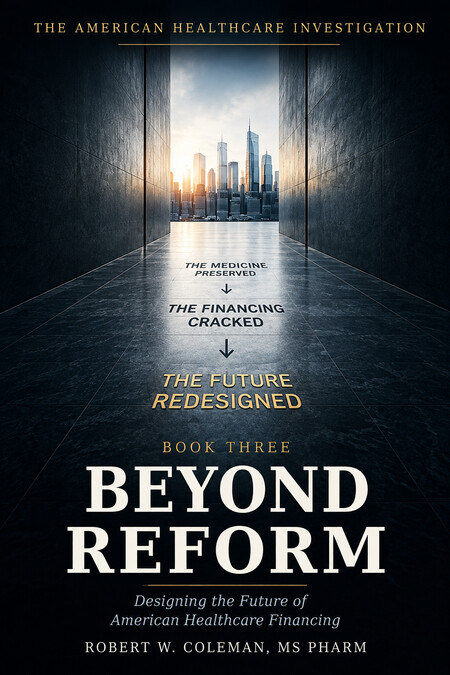
Book Three, Beyond Reform, asks the question the first two books earn the right to ask: if we were designing this system today, knowing everything the investigation has revealed, what would we build?
A note on names: Book Two and Book Three were drafted under the working titles Hostile Takeover and Replace, Don't Reform before being renamed to Behind the System and Beyond Reform. Those original titles now belong to two separate, independently published books — Hostile Takeover (eBook, audiobook, and video series) and Replace, Don't Reform (the short citizen's guide featured on the single-payer page). They are four distinct books that share thematic ground, not the same book listed twice.
The narrator throughout is an investigator, not an activist — never a politician, a lobbyist, or an ideologue. The books critique systems, not people; American medicine and the professionals who practice it are treated throughout as one of the country's genuine achievements. Every major factual claim is documented, drawing on government data, peer-reviewed research, and primary sources rather than opinion. No single villain is ever named, because the investigation's central discovery is more unsettling than a villain: a system in which nearly every participant can honestly say they followed the rules, and the outcome is still one that almost no one would defend.
Readers who finish the trilogy are not handed a verdict. They are handed something more durable — a clear, evidence-based understanding of how American healthcare financing actually works, and the standards by which any proposal to change it, from any direction, can be fairly judged.
“A system in which nearly every participant can honestly say they followed the rules — and the outcome is still one that almost no one would defend.”