Kindle eBook
Unnecessary Deaths
How the Trump Administration Undercut(s) Global and US Health Care and Medical Science
About the book →Coleman Publishing · 2026
How Wall Street and Congress Hijacked American Healthcare and How We Can Take It Back
In May 2025, a diagnostic test at a cancer care center came back with a bill for $31,272.25. After a five-month "review," the insurer paid $0.00.
This book begins with a shocking premise: the American healthcare system is not broken. It is working exactly as designed.
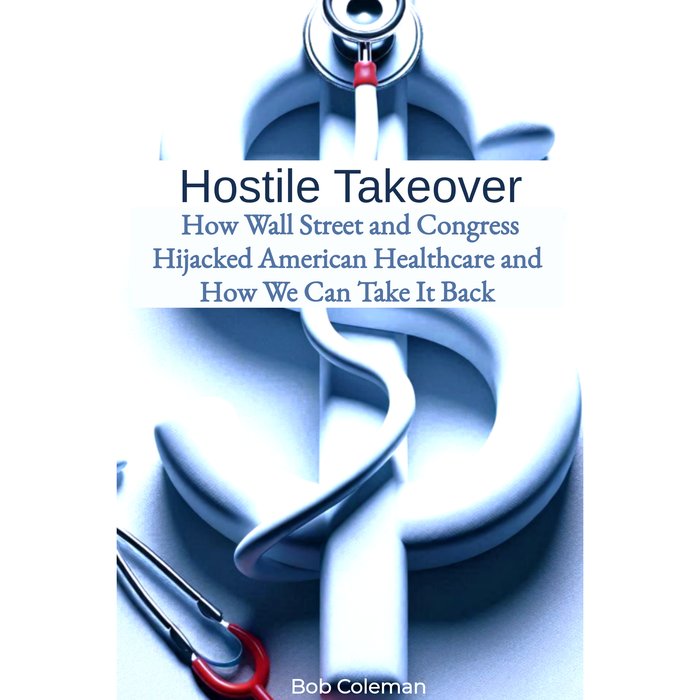
If you have American health insurance, you've seen the words on an Explanation of Benefits: "This is not a bill." It's a document that often precedes financial ruin anyway.
The soaring costs, the denied claims, the paperwork, the medical bankruptcies — this book argues they aren't the result of incompetence. They're features of a system engineered for one purpose: generating returns for shareholders by limiting how much care patients actually receive. The EOB is the mechanism that transfers risk from corporations to families.
Hostile Takeover traces that machinery from the individual denial, to the human cost it produces, to the political protection racket that keeps it profitable — and then spends its final chapters on the counter-offensive: a federal blueprint built on the VA, and a state-level blueprint already drafted in Washington state.
“The American healthcare system is not broken. It is working exactly as designed.”— Introduction
The first seven chapters expose the mechanics of the takeover — the denial machine, the human damage, the fraud, the political machinery protecting it. The final three lay out a citizen's blueprint for reclaiming the system, built on institutions that already work.
The federal blueprint leverages the VA and Medicare, systems already operating at scale. The state blueprint points to a specific, drafted bill — Washington state's Washington Health Trust — as a working Phase One prototype.
Robert Coleman's prior book asked why people were getting hurt, sick, or dying when solutions existed. Hostile Takeover picks up where that left off, asking who and how — who is behind the failures, and how the system was deliberately reshaped to prioritize profit over stability.
The Evidence
Nearly 50 million Medicare Advantage prior-authorization determinations were issued in 2023 alone. When patients or providers actually push back, the reversal rate suggests most of those initial denials should never have happened — a system that profits from exhaustion, not error.
| Documented impact | Figure |
|---|---|
| Patients who report a measurable health decline during a claim-denial waiting period | 60% |
| Patients denied care who never receive the treatment at all | ~1 in 4 |
| Higher preventive-care denial rate for Asian, Hispanic, and Black patients vs. white patients | nearly double |
| Physician time spent weekly on insurer administration rather than patients | ~20 hours |
| U.S. physician burnout rate vs. the general workforce | 82% higher |
| 2025 DOJ healthcare fraud takedown — the largest in U.S. history, 324 defendants charged | $14.6B |
The book's central counter-example is the VA — the country's own largest single-payer-style system. Veterans treated at VA hospitals show a 4.5 percentage point higher 28-day survival rate than those treated at private facilities, while costing 21% less per episode of care, even as the VA faces proposed staffing cuts of over 17% of its workforce.
“The VA proves that when you remove the profit motive, you can provide better care for less money.”— Chapter 7
Figures above are drawn directly from the book's sourced chapters and its 2025 DOJ, HHS, CDC, and peer-reviewed citations. The book's own annotated bibliography documents each source.
Contents
Conclusion — Logical, Moral and Economical Endgame. Plus two appendices: a look at the 2026 healthcare coverage crisis as enhanced ACA subsidies lapse, and a full annotated bibliography.
Chapter 9's state-level counter-offensive isn't hypothetical. It points directly to the Washington Health Trust — the same drafted legislation covered in depth in One Card, One Cure and the case for single-payer healthcare elsewhere on this site.
This standalone book is a separate, independent publication from Behind the System, Book Two of The American Healthcare Investigation trilogy — which was originally drafted under the working title "Hostile Takeover" before being renamed. The two share only that drafting history, not content or series membership. How the two relate.
A $31,272.25 bill. An insurer that paid $0.00.
The system isn't broken. It's working exactly as designed.
Every figure on this page is documented and sourced in the book's own annotated bibliography.