Kindle eBook
Hostile Takeover
How Wall Street and Congress Hijacked American Healthcare and How We Can Take It Back
About the book →Coleman Publishing · 2025
How the Trump Administration Undercut(s) Global and US Health Care and Medical Science
An estimated 1.3 million excess deaths occurred in the United States between 2020 and 2022. Independent research puts the preventable share at 130,000 to more than 300,000 — deaths tied to specific, documented policy choices, not chance.
This book asks how many lives were lost, and how many more are already at risk, because of decisions already made.
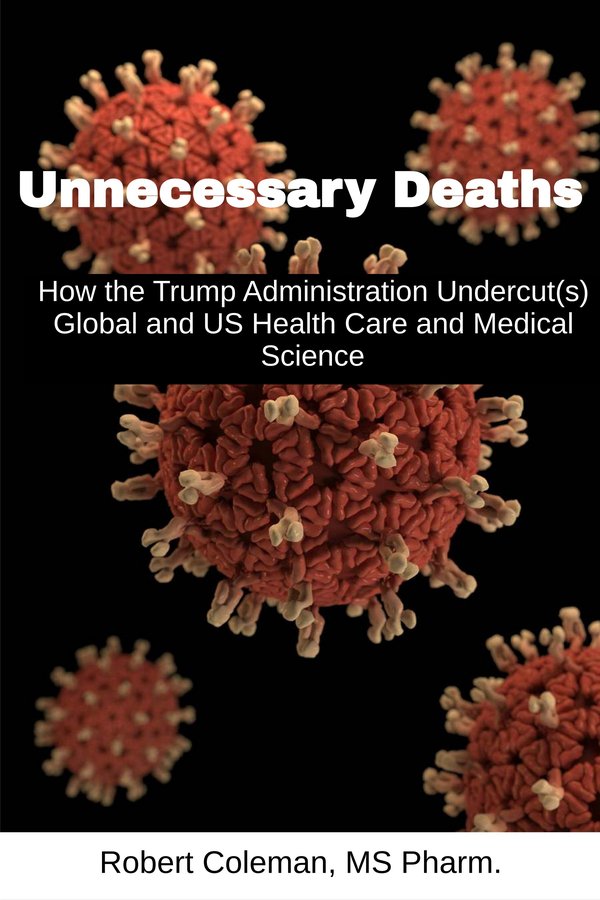
The book starts from a precise definition. Excess deaths are observed deaths minus expected deaths, based on pre-pandemic trends — a number the CDC's own excess-mortality data puts at roughly 1.3 million for the U.S. between 2020 and 2022. Unnecessary deaths are the fraction of that number tied directly to specific, avoidable policy failures: defunded preparedness, sidelined scientists, and disinformation given an official platform.
By June 2020 the U.S. was recording 142 COVID deaths per 100,000 people — nearly triple Germany's rate and far above Japan's. That gap wasn't inevitable. It traces to identifiable decisions, made years before the virus arrived and repeated after.
“'Unnecessary' wasn't an opinion — it was a math problem. And America had shown its work.”— Chapter 2
The book leans on Disability-Adjusted Life Years and comparative modeling — standardized epidemiological tools — rather than raw outrage, to separate what's measured from what's projected.
From a 2018 pandemic-simulation shutdown, to a 2019 depleted stockpile, to 2020's testing failures, to the anti-science rhetoric that followed — and forward again, to the domestic and global policy proposals the book argues would repeat the same failures.
Written in 2025, Unnecessary Deaths represents the beginning of the author's effort to document how misinformation and eroded public trust translate into a body count — work that continues in Hostile Takeover and When Science Became Political.
The Evidence
During the Delta-dominant period (Oct.–Dec. 2021), unvaccinated Americans were roughly 12.7 times more likely to die of COVID-19 than fully vaccinated people — and more than 50 times more likely than those who had also received a booster (CDC, MMWR). Across 164 countries, a 10-percentage-point rise in vaccination coverage was associated with an 18% drop in COVID-19 mortality six months later.
| Documented event | Consequence |
|---|---|
| 2018: "Crimson Contagion" pandemic simulation shut down, findings buried | 37% slower contact tracing (BMJ, 2021) |
| 2019: HHS Inspector General finds Strategic National Stockpile depleted | 90% of PPE expired, missing, or depleted |
| Jan. 2020: CDC's first COVID test kits contaminated, unusable | Weeks of undetected spread in Seattle, NY, Chicago |
| 2021–present: Public health workforce attrition | ~130,000 local/state health jobs lost |
| Confidence in CDC officials, 2024 (Pew Research) | 44% of U.S. adults |
The costs weren't only domestic. When PEPFAR-supported clinics abroad lost funding stability, vaccination rates collapsed — the WHO linked a resulting measles outbreak in the Democratic Republic of Congo to more than 7,000 child deaths in 2019–2020 alone.
“The next pandemic is coming. The only question is whether we'll call those deaths unnecessary too.”— Chapter 2
Figures above are drawn directly from the book's cited sources: CDC, HHS Office of Inspector General, Columbia University, IHME/The Lancet Commission, MMWR, Pew Research, and the WHO, among others documented in the book's own annotated bibliography.
Contents
Conclusion — The High Cost of Forgetting. A blueprint for accountability, resilient funding, and rebuilding public trust — plus a policy chronology (2018–2024), a glossary, and a full annotated bibliography.
The conclusion doesn't stop at diagnosis. It sets out three concrete directions: hold the sources of disinformation accountable, rebuild permanent and depoliticized funding for pandemic preparedness, and integrate media literacy into how the next generation evaluates evidence.
“The data is clear. The solutions are known. The autopsy of the last pandemic provides a perfect blueprint for preventing the next one. The only thing missing is the will to act.”
When Science Became Political: The Crisis Inside NIH, CDC, and HHS is a separate, standalone investigation — not part of an Unnecessary Deaths series, despite the overlapping subject matter. Each book stands on its own sourcing and scope. A true companion volume, Unnecessary Deaths: A Thesis in Five Pillars, expands this book's argument around five converging failures.
1.3 million excess deaths, 2020–2022. Up to 300,000-plus judged preventable.
The autopsy is already written. The next chapter isn't.
Every figure on this page is documented and sourced in the book's own annotated bibliography.